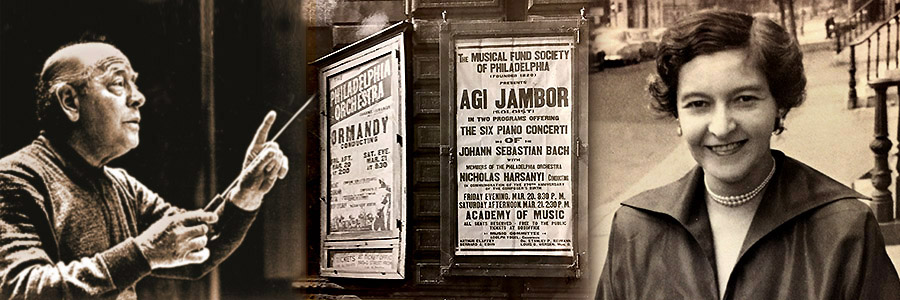
I first encountered the name Agi Jambor in 2009, when a man called Stephen – one of her friends – uploaded several of her recordings to YouTube. I was stunned by the beauty of her playing, and fascinated by her life story – one worthy of a Hollywood movie.
The daughter of a businessman and a prominent Jewish piano teacher, Jambor was born in Budapest in 1909 and made her debut with a symphony orchestra at the age of 12. In the late 1920s, she studied with the renowned pianist Edwin Fischer in Berlin. While there, she met many remarkable figures, including Albert Einstein, through his companion Toni Mendel.
“She asked me what I wanted for my birthday. I said, ‘Einstein!’ On my birthday, I opened the door and there he was.”
They spent the evening playing Mozart sonatas.
“He was like a child, so endearing, except for the wrong notes. I don’t think he ever practised.”
By the early 1930s, Jambor was already an established pianist. Yet she did not seem particularly interested in the life of a concert pianist. She moved to Paris and chose to play the piano in a dance studio rather than on stage.
In 1933 she married Imre Patai, a physicist and pianist. They had a baby boy who died within weeks of birth. A picture of the infant remained on her bedside table for the rest of her life.
In 1937, at the urging of her husband, she entered the Chopin International Piano Competition in Warsaw and won fifth prize.
By then, Europe was becoming increasingly dangerous for Jews. When the Nazis invaded Hungary in 1944, Jambor joined the Resistance. Disguised as a streetwalker – wearing heavy makeup, flashy clothes, and calling herself Maryushka – she narrowly escaped death several times during the bombings.
After the war, she never returned to Germany.
“These were the same people who had produced Bach and Beethoven, Goethe and Schiller. I still don’t understand how a country with such culture could have killed so ruthlessly.”
In 1947 she moved to the US with her husband. He died two years later from a heart attack brought on by exposure to coal gas from a faulty heating unit.
“It was a dark joke of life that he survived the war, German occupation and seven terms in prison, and he had to die because of a broken heating system.”
Jambor established herself as a pianist in the US, performing in New York, Washington and Philadelphia, and receiving rave reviews. She made several recordings but turned down a national tour.
“If you do not sell your soul, it is difficult to build a career. You need to make a concert programme that interests an audience, even if you don’t like it. I did what I wanted to do, not what I had to. I do not play for success; I play to bring life to the composer.”
There was no false modesty behind the statement. Jambor had plenty of opportunities to become considerably more famous, but she was unwilling to shape her life around the demands of the profession.
In 1949, shortly after the death of her husband, Jambor composed a piano sonata. The little-known work adds another dimension to her: it reveals that she was not only an exceptional pianist, but also a composer whose experience of war and loss found direct expression in her music.
This is a pattern that would recur throughout Jambor’s life: moments of great significance would disappear from view, only to resurface many years later.
In 1959 she met Hollywood actor Claude Rains at a dinner party. He was taken with the fact that she had no idea who he was. They married that same year. She was his fifth wife.
Through Rains, she met various film stars, including Bette Davis.
“It seemed like she was so rough-tough, but she liked me to play music for her.”
The marriage was short-lived. After a mysterious bout of encephalitis, Jambor withdrew from public life once again. For many years, she lived entirely alone, surrounded mainly by her cats and her music.
Then, in the late 1980s, her life took an unexpected turn. After listening to one of her recordings, psychiatrist Joseph Stephens – who had heard Jambor live in concert – decided to track her down. Just before her 80th birthday, he persuaded her to move, along with her two pianos and a large multilingual library, to the Beethoven Apartments in Bolton Hill, Baltimore.
Her life began again.
Stephens, an accomplished harpsichordist, would walk to her new apartment every day. Sometimes he listened as she played pieces she had not touched in decades; sometimes they played two-piano repertoire together. With the help of his partner, Lloyd, and a wide circle of friends, he made sure Jambor was almost never alone.
On the day she died, in 1997, Jambor told her friend Joe Stephens that thanks to him, she’d been the happiest woman in the world during the last eight years of her life.

